Tucked away in the serene Vasavi Colony of Kothapet, Hyderabad, the Ashtalakshmi Temple stands as one of the most spiritually rich landmarks in Telangana. Dedicated to Goddess Lakshmi in all her eight divine forms, this temple draws thousands of devotees every week who seek blessings for wealth, health, knowledge, and overall well-being.
What makes this temple truly special is its rare concept — worshipping all eight manifestations of Goddess Lakshmi under one roof. In a city better known for its Nizami heritage and Islamic monuments, this South Indian-style shrine offers a completely different spiritual experience. Whether you are a devout pilgrim or a curious traveler, a visit here leaves a lasting impression.
History of Ashtalakshmi Temple Hyderabad
The Ashtalakshmi Temple in Hyderabad was consecrated in April 1996 under the divine guidance of Sri Jayendra Saraswathi Swamiji of the Kanchi Kamakoti Peetam, one of the most respected spiritual institutions in South India. The initiative brought together people from all walks of life, who contributed generously to make this dream a reality.
Construction of the temple took approximately five years to complete, with a total expenditure of around Rs. 20 million (2 crore rupees). The project was spearheaded with deep devotion and strict adherence to Agama Shastra — the ancient Hindu code governing temple construction and rituals.
The temple’s design was conceptualized by Padmashri S.M. Ganapathy Sthapati and brought to life by sculptor Subbaiah Sthapati, who crafted the stunning idols of Lord Srimannarayana, Lord Ganesha, and the Ashtalakshmi forms. The structure was modeled after the famous Sri Ashtalakshmi Temple in Chennai, Tamil Nadu, though several unique modifications were made to give the Hyderabad temple its own identity.
Over the years, the temple has witnessed several development phases, including proposals for a multi-storied parking facility, an Archaka Nilayam (priests’ quarters), and a Kalyana Mandapa. Today, it remains a thriving center of Vaishnavite devotion and South Indian religious culture in Hyderabad.
The Eight Forms of Goddess Lakshmi (Ashta Lakshmi)
The word “Ashtalakshmi” is a combination of two Sanskrit words: “Ashta” (meaning eight) and “Lakshmi” (Goddess of Wealth). Together, they signify the eight divine manifestations of Goddess Lakshmi, each representing a unique dimension of prosperity and abundance.
This concept beautifully communicates that true prosperity is not limited to money alone — it encompasses courage, knowledge, food, family, victory, and spiritual grace.
Significance of Each Form of Lakshmi
- Adi Lakshmi – The primordial form of Lakshmi, representing divine energy and the source of all creation. She is the original mother goddess who blesses devotees with spiritual liberation.
- Dhana Lakshmi – The goddess of material wealth and financial prosperity. She is invoked for monetary abundance and economic stability.
- Dhanya Lakshmi – The goddess of agricultural wealth and nourishment. She blesses devotees with food, grain, and physical sustenance.
- Gaja Lakshmi – Depicted flanked by two elephants, she represents animal wealth, royal power, and abundance. She is a symbol of grace and good fortune.
- Santana Lakshmi – The goddess of progeny and family happiness. Couples seeking children or family harmony pray especially to this form.
- Vijaya Lakshmi – The goddess of success and victory. She is worshipped to overcome obstacles and achieve triumph in all endeavors.
- Vidya Lakshmi – The goddess of knowledge, wisdom, and education. Students and scholars seek her blessings for intellect and learning.
- Dhairya Lakshmi (Vara Lakshmi) – The goddess of courage, patience, and inner strength. She empowers devotees to face life’s challenges with fortitude.
Architecture of Ashtalakshmi Temple Hyderabad
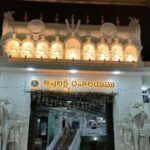
The Ashtalakshmi Temple is a visual treat that stands out dramatically against the predominantly Mughal-influenced skyline of Hyderabad. Painted in gleaming white and set atop a small hillock, the temple is visible from a distance and glows brilliantly when illuminated at night.
Presiding Deities and Other Shrines
The sanctum sanctorum houses all eight idols of Goddess Lakshmi, each crafted from sand and cement and adorned with precious gems, gold jewelry, and traditional necklaces. The installation process followed rigorous Vedic rituals to ensure spiritual purity.
Apart from the Ashtalakshmi forms, the temple also contains shrines for:
- Lord Srimannarayana – The presiding male deity of the temple
- Lord Ganesha – The remover of obstacles, placed at the entrance
- Garuda – The divine vehicle of Lord Vishnu, installed opposite to Srimannarayana
- A dedicated Yagna Shala where sacred fire rituals (homas) are conducted daily
The temple’s mahagopuram (main tower) is particularly noteworthy — it houses approximately 134 vigrahas (idols) of various gods and goddesses, making it a spiritual encyclopedia in stone.
Unique Architectural Features
- Inspired by Dravidian temple architecture of Tamil Nadu
- Designed by renowned Sthapatis (traditional temple architects) following ancient building codes
- White exterior with intricate stone carvings along the gopuram
- A peaceful courtyard that creates a meditative atmosphere
- A Yagna Shala within the premises for daily fire rituals
- Anna Daanam (free food offering) and Gograsam (grass offering to cows) performed on the premises
Ashtalakshmi Temple Hyderabad Timings
The temple is open to devotees every day of the week. Below are the general darshan timings:
| Day | Morning | Evening |
| Monday to Saturday | 6:00 AM – 12:00 PM | 5:00 PM – 9:00 PM |
| Sunday | 6:00 AM – 1:00 PM | 5:00 PM – 9:00 PM |
Note: During major festivals and special occasions, timings may be extended. It is advisable to check with the temple administration before planning your visit.
Daily Poojas and Sevas
The temple follows a rich schedule of daily rituals rooted in the Agama tradition:
- Suprabhata Seva – 5:00 AM (Morning awakening of the deity with sacred hymns)
- Abhishekam – 6:30 AM (Ceremonial bathing of the deity)
- Morning Aarti – 7:00 AM
- Kalasandhi Pooja – 8:00 AM to 9:30 AM
- Uchikala Pooja – 11:45 AM (Afternoon worship)
- Evening Aarti – 6:00 PM
- Arthajama Pooja – 8:45 PM to 9:00 PM (Final worship of the day)
A special Abhishekam to Mahalakshmi and Sriman Narayana is performed every Friday, making it the most auspicious day to visit the temple.
Entry Fee and Darshan Details
There is no entry fee to visit the Ashtalakshmi Temple in Hyderabad. Darshan is free for all devotees throughout the week.
However, devotees can participate in special sevas and poojas for a nominal offering:
- Sri Mahalakshmi Yantra Archanam – Special ritual for goddess blessings
- Abhishekam Seva – Ceremonial bathing of the deity
- Vastra Samarpana – Offering of sacred clothes to the deity
It is recommended to arrive early on Fridays and festival days to avoid long queues.
Major Festivals Celebrated
The Ashtalakshmi Temple is a hub of devotional energy throughout the year, with several major festivals celebrated with grandeur:
- Varalakshmi Vratam (July–August) – One of the most important festivals, especially for women seeking blessings for family prosperity
- Durga Navratri / Navaratri (September–October) – Celebrated with special pujas, cultural programs, and heavy devotee turnout
- Diwali (Festival of Lights) – Special darshan and illumination of the temple
- Vaikunta Ekadashi – A sacred day for Vaishnavites with extended darshan timings
- Annual Brahmotsavam – A grand multi-day celebration attracting pilgrims from across Telangana and Andhra Pradesh
- Fridays and Full Moon Days – Weekly special poojas with high devotee attendance
How to Reach Ashtalakshmi Temple Hyderabad
The temple is located at Plot No. 52–55, Vasavi Colony, Ramakrishnapuram, Kothapet, Hyderabad, Telangana – 500035, situated along NH 9 between Dilsukhnagar and LB Nagar.
By Road:
- Well-connected via TSRTC (Telangana State Road Transport Corporation) buses
- Private taxis, autos, and app-based cabs are easily available
- The nearest bus stop is Dilsukhnagar
By Metro:
- The Dilsukhnagar Metro Station on the Blue Line is the closest metro stop, followed by a short auto or cab ride
By Train:
- Hyderabad Deccan Railway Station (HYB) – approximately 9 km away
- Secunderabad Junction (SC) – approximately 12.8 km away
By Air:
- Rajiv Gandhi International Airport, Shamshabad – approximately 25–28 km from the temple; taxi services are readily available
Best Time to Visit
The ideal time to visit the Ashtalakshmi Temple is between October and March, when Hyderabad’s weather is pleasant and cool. This period also coincides with major festivals like Navratri, Diwali, and Vaikunta Ekadashi, adding a festive charm to your visit.
Fridays are considered the most auspicious day for Lakshmi worship. Arriving early in the morning (by 7:00 AM) helps you enjoy a peaceful darshan before the crowds build up.
Avoid visiting during peak summer afternoons (April–June), as temperatures can be quite high.
Spiritual Benefits of Visiting Ashtalakshmi Temple
Devotees who visit this temple with a sincere heart believe they receive blessings across multiple dimensions of life:
- Financial prosperity through Dhana Lakshmi’s blessings
- Good health and vitality through the grace of Gaja Lakshmi
- Academic excellence through Vidya Lakshmi’s divine energy
- Family happiness and fertility through Santana Lakshmi’s blessings
- Courage and resilience invoked through Dhairya Lakshmi
- Victory in career and personal goals through Vijaya Lakshmi
- Spiritual growth and moksha through Adi Lakshmi’s grace
- Food security and abundance through Dhanya Lakshmi
The concept of worshipping all eight forms together is rooted in the belief that holistic prosperity — covering all aspects of human life — can only be achieved by seeking the blessings of every form of Lakshmi.
Nearby Temples and Attractions
If you are visiting the Ashtalakshmi Temple, consider exploring these nearby spiritual and cultural landmarks:
- Birla Mandir, Hyderabad – A stunning white marble temple on Naubat Pahad hill, dedicated to Lord Venkateswara
- Charminar – The iconic 16th-century monument and mosque in the heart of Hyderabad’s old city
- Ujjaini Mahankali Temple, Secunderabad – Famous for the grand Bonalu festival
- Sri Ganesh Temple, Secunderabad – A popular temple known for its peaceful atmosphere
- Akkanna Madanna Temple, Hyderabad – A historically significant temple with deep cultural roots
- Hussain Sagar Lake – A picturesque lake in the heart of the city, perfect for an evening stroll
Visitor Guidelines and Temple Etiquette
To maintain the sanctity of this sacred space, all visitors are requested to follow these guidelines:
- Dress modestly and in traditional attire — Western clothing that is revealing is discouraged
- Remove footwear outside the temple premises before entering
- Maintain silence inside the temple and speak softly
- Photography is prohibited inside the sanctum sanctorum
- Follow the queue system patiently, especially during peak hours and festivals
- Switch off or silence mobile phones inside the temple
- Do not consume non-vegetarian food or alcohol on the day of your visit
- Respect the rituals in progress — avoid disrupting ongoing poojas
Frequently Asked Questions
Where is Ashtalakshmi Temple located in Hyderabad?
The temple is located at Vasavi Colony, Ramakrishnapuram, Kothapet, Hyderabad – 500035, near the Dilsukhnagar area on NH 9.
What are the Ashtalakshmi Temple Hyderabad timings?
The temple is open from 6:00 AM to 12:00 PM and 5:00 PM to 9:00 PM daily; Sunday morning timings extend to 1:00 PM.
Is there an entry fee at Ashtalakshmi Temple Hyderabad?
No, entry to the temple is completely free for all devotees. Special sevas may involve a nominal offering.
Which day is most auspicious to visit Ashtalakshmi Temple?
Friday is the most auspicious day for Lakshmi worship, with special Abhishekam performed for Mahalakshmi and Sriman Narayana.
When was the Ashtalakshmi Temple Hyderabad built?
The temple was consecrated in April 1996 under the guidance of Sri Jayendra Saraswathi Swamiji of the Kanchi Kamakoti Peetam.
Who designed the Ashtalakshmi Temple in Hyderabad?
The temple was designed by Padmashri S.M. Ganapathy Sthapati, modeled after the Ashtalakshmi Temple in Chennai with unique modifications.
What is the nearest metro station to Ashtalakshmi Temple?
Dilsukhnagar Metro Station is the closest metro stop, just a short auto ride away from the temple.
Is photography allowed inside the temple?
Photography is not permitted inside the main sanctum. Visitors are requested to respect this rule.
Final Thoughts
The Ashtalakshmi Temple in Hyderabad is far more than a place of worship — it is a living testament to the idea that true prosperity is multidimensional. By honoring all eight divine forms of Goddess Lakshmi, this temple invites every devotee to look beyond material wealth and seek abundance in knowledge, courage, family, food, and spiritual peace.
Whether you come for the Friday Abhishekam, the festive grandeur of Navratri, or simply a quiet morning darshan, the temple wraps you in a deep sense of calm and divine grace. Its South Indian architecture, the illuminated white structure, the fragrance of incense, and the sound of vedic chants create an experience that stays with you long after you leave.
If you are in Hyderabad or planning a trip, make the Ashtalakshmi Temple a definite part of your itinerary. Seek the complete blessings of the Ashtalakshmi and carry home not just memories, but divine grace in every form.