If you are planning a pilgrimage to Rajasthan in 2026, few experiences compare to standing inside the Haveli of Shrinathji at Nathdwara during the Rajbhog jhanki. The temple does not work like a typical Hindu shrine that stays open all day. Instead, it runs on a schedule built around the daily routine of a living child, and understanding that rhythm is the single most important thing you can do before you travel.
This guide brings together verified darshan timings, the temple’s history, the online booking process, travel routes, and practical tips so you can plan a smooth and meaningful visit without wasting hours at the gate.
Shrinathji Temple Nathdwara
Shrinathji Temple sits on the right bank of the Banas River in Nathdwara, a small temple town in the Rajsamand district of Rajasthan, about 48 km northeast of Udaipur. The name Nathdwara literally means “gateway to the Lord,” and the town grew entirely around this one shrine.
The temple is dedicated to Shrinathji, a seven year old form of Lord Krishna shown with his left arm raised to lift the Govardhan hill and protect the villagers of Braj from torrential rain. Unlike most Krishna temples that follow the adult Vaishnav tradition, Shrinathji is worshipped as Pushti Marg’s central deity, the devotional path founded by Sri Vallabhacharya. Devotees do not simply view the deity; they participate in his daily life as one would care for a beloved child, through waking, bathing, dressing, feeding, and finally putting him to rest.
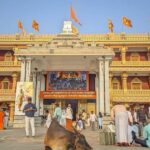
Locally, the temple complex is called the Haveli, meaning mansion, because its architecture and daily rituals mirror a royal household rather than a conventional stone temple with a tall spire. This single detail explains almost everything about how a visit here differs from other pilgrimage sites in India.
History of Shrinathji Temple
Devotees trace the idol’s history back thousands of years to Vajranabha, Krishna’s great grandson, believed to have installed the deity on Govardhan Hill near Mathura. For centuries it remained a quiet, local object of worship in Braj.
Everything changed in 1669, when Emperor Aurangzeb ordered the demolition of major Hindu temples across northern India. The priests of the Pushti Marg sect realised the deity was no longer safe and began a secretive journey toward Mewar, where Maharana Raj Singh had promised protection. The idol travelled along the Yamuna and was kept at Agra for nearly six months before moving further south. By late 1671, it reached the border of Mewar, where Raj Singh personally received it, and the temple was consecrated on 20 February 1672 under Goswami Damodar Das.
More than a century later, in 1802, Maratha commander Jaswant Rao Holkar advanced toward Nathdwara, prompting Maharana Bhim Singh to send an armed escort that moved the deity safely to Udaipur until the danger passed, a reminder of how closely the temple’s fate has been tied to the region’s history.
Legend of Shrinathji Temple
Ask anyone in Nathdwara why the temple stands exactly where it does, and they will tell you the same story passed down for over 350 years.
As the chariot carrying Shrinathji moved deeper into Mewar in search of a permanent refuge, it reached a modest village called Sihad. There, without warning, the wheels of the cart sank deep into the mud and simply would not budge, no matter how much effort the escorting priests and soldiers put in.
The accompanying priests took this as a divine sign. They believed the Lord himself had chosen this exact spot as his permanent home and had no intention of travelling any further. Maharana Raj Singh accepted this interpretation, and construction of the temple began right there. Over time, Sihad was renamed Nathdwara, and the small village transformed into one of the most important pilgrimage centres for Krishna devotees in India.
Architecture of Shrinathji Temple
Shrinathji Temple deliberately avoids the towering shikhara style seen at most North Indian temples. Instead, the complex is built like a large haveli, a sprawling home with courtyards, chambers, kitchens, and storerooms, reflecting the belief that Shrinathji lives here as a member of a royal household rather than as a distant, untouchable god.
Some defining architectural and artistic features include:
- A sacred black marble idol depicting the deity with his left hand raised and right hand resting in a fist at the waist, with a large diamond placed beneath the lips.
- Multiple internal courtyards and sections, including the main sanctum, kitchens for preparing bhog offerings, a stitching department where tailors create the deity’s daily outfits, and priests’ residential quarters.
- Silver and gold utensils used in daily rituals, reflecting the temple’s status as one of the wealthiest in India.
- A rich tradition of Pichwai paintings, large cloth backdrops hung behind the idol that change according to the season and festival, which gave birth to an entire school of Rajasthani art still practised in Nathdwara today.
- No mobile phones, cameras, or leather items are permitted inside the haveli, preserving both the sanctity and the intimacy of the space.
Shrinathji Temple Timings
The temple functions on what is called the Ashta Yama seva, or eight daily jhankis (glimpses), rather than staying open continuously. Each jhanki represents a specific moment in Shrinathji’s day, and the doors close completely between sessions.
| Jhanki | Approximate Timing | What It Represents |
| Mangala | 5:30 AM to 6:30 AM | The Lord waking up in the morning |
| Shringar | 7:15 AM to 7:45 AM | Adornment with fresh clothes and jewellery |
| Gwal | 9:15 AM to 9:45 AM | Departure with the cows for grazing |
| Rajbhog | 11:15 AM to 12:15 PM | The grand midday meal offering |
| Utthapan | 3:30 PM to 4:00 PM | Waking from the afternoon rest |
| Bhog | 4:45 PM to 5:15 PM | Evening snack offering |
| Sandhya Aarti | 5:15 PM to 6:15 PM | Evening prayer as the cows return |
| Shayan | 7:30 PM to 8:00 PM | Final darshan before the Lord rests |
Keep in mind that these timings shift slightly during Ekadashi, Janmashtami, Holi, Diwali, and other major festivals. Always confirm the current schedule on the official website or the temple notice board before you travel.
Best Time to Visit Shreenathji Temple
The most comfortable months to visit Nathdwara are October through March, when Rajasthan’s weather is mild and pleasant enough for long queues and outdoor walking between darshans. Summers, from April to June, get extremely hot, and the monsoon months bring humidity along with occasional travel disruptions.
Within the day, weekday mornings offer the calmest experience, particularly the Mangala and Shringar jhankis, before tour groups and weekend crowds arrive. If your goal is a peaceful, unhurried darshan, avoid weekends, Ekadashi dates, and the days surrounding major festivals unless you specifically want to witness the festive grandeur, in which case book well in advance.
Shrinathji Temple Darshan Timings
Darshan follows the eight jhanki windows listed above, and there are a few practical rules every visitor should know:
- Once a jhanki window closes, the doors do not reopen for latecomers. You must wait for the next scheduled session.
- Rajbhog is widely considered the most spiritually significant and visually elaborate darshan of the day.
- Arriving 30 to 45 minutes before your chosen jhanki is recommended, especially for Mangala and Rajbhog, since these fill up fastest.
- The temple closes for a few hours in the early afternoon, between Rajbhog and Utthapan, so plan your day around this gap rather than waiting outside.
Entry Fees at Shrinathji Temple
General darshan at Shrinathji Temple is completely free of charge for every devotee. There is no entry ticket required for the standard queue.
That said, the temple does offer paid options for those who prefer a shorter wait or a more personalised experience:
- VIP or special entry darshan typically costs between ₹300 and ₹500 per person.
- Specific sevas and rituals booked directly with the temple can range anywhere from ₹250 to ₹5,000 or more, depending on the type and scale of the offering.
VIP Darshan & Seva Options
For devotees who want a calmer, closer, or more personally meaningful experience, several paid options exist alongside the free general darshan:
- VIP Darshan Pass: Grants faster entry through a separate, shorter queue during regular jhanki hours.
- Manorath Seva: A special personalised offering performed on behalf of a devotee or family.
- Rajbhog and Shayan Bhog Seva: Sponsoring a portion of the meal offerings made to the deity during these two significant jhankis.
- Annadan Seva: Contributing toward food distribution for pilgrims and the needy.
- Vastra Seva: Sponsoring new garments for the deity.
- Phool Seva: Sponsoring the flower decorations used in the day’s jhankis.
These can usually be booked online in advance or arranged through authorised temple counters on the day of your visit.
Shrinathji Temple Online Darshan Booking 2026
To avoid long waits and uncertainty at the gate, the temple strongly encourages advance booking through its official website, especially during weekends, festivals, and peak tourist season. Here is the general process:
- Visit the official website, nathdwaratemple.org.
- Register using your mobile number and email address if you are a first time visitor, or log in with your existing credentials.
- Select the darshan or seva booking option from the menu.
- Choose your preferred visit date and the specific jhanki slot you want. Popular slots like Mangala and Rajbhog tend to fill up quickly, so book early.
- Enter accurate devotee details, including full name, age, and a valid ID number for every person included in the booking.
- Complete payment if you have selected a paid VIP or seva slot. General darshan booking usually does not require payment.
- Download and save your e-ticket as a PDF. Carry either a printed copy or a saved digital version on your phone, along with valid photo identification, when you arrive at the temple.
Since online systems and slot availability can change from season to season, always cross check the latest instructions on the official portal shortly before your trip.
Required Documents for Booking
Keep the following ready when you book darshan or seva slots, and again when you enter the temple premises:
- A valid government photo ID such as Aadhaar card, PAN card, voter ID, or passport.
- An active mobile number for OTP verification and booking confirmations.
- A valid email address to receive your e-ticket.
- Full names and ages of every devotee included in a group or family booking.
- A printed or downloaded copy of your confirmed e-ticket.
How to Reach Shrinathji Temple?
Nathdwara is well connected to major cities in Rajasthan and neighbouring states, and most visitors combine it with a broader Udaipur itinerary.
By Air
The nearest airport is Maharana Pratap Airport in Dabok, Udaipur, located roughly 50 km from Nathdwara. It has regular domestic flights connecting Udaipur to Delhi, Mumbai, Jaipur, and other major Indian cities. From the airport, taxis and pre booked cabs are readily available for the onward drive.
By Train
Udaipur City railway station, about 48 km away, is the most convenient rail head, with direct and connecting trains to Delhi, Mumbai, Ahmedabad, Jaipur, and Chittorgarh. From the station, shared taxis, private cabs, and local buses run frequently to Nathdwara.
By Road
Nathdwara sits on a well maintained highway network linking it to Udaipur, Chittorgarh, and Ahmedabad. State transport buses, private coaches, and taxis operate throughout the day from Udaipur’s main bus stand, and the drive itself takes about an hour under normal traffic conditions. If you are driving from Ahmedabad or Jaipur, expect a journey of five to six hours depending on your starting point.
Rituals in Shrinathji Temple
Every ritual at Shrinathji Temple flows from one central idea: the deity is treated exactly as a beloved young child, not as a distant, unreachable god. This is why the entire day is broken into short darshan windows instead of one long, continuous viewing period.
Each of the eight daily jhankis carries its own specific ritual purpose, from waking and dressing the deity in the morning to offering meals at midday and evening, and finally settling him for the night. Priests, known as Goswamis, personally conduct bathing, dressing, and feeding rituals behind closed doors, and devotees are only invited in during the brief windows when the doors open.
On festival days, additional rituals are added, most famously the Annakut celebration, when a mountain of fifty six different food items, known as Chappan Bhog, is offered to the deity in a single spectacular display. Devotees are asked to maintain silence, modest dress, and complete respect for the no phone and no photography rules inside the haveli at all times.
Festivals in Shrinathji Temple
Nathdwara transforms completely during its major festivals, drawing pilgrims from across India and abroad. The most significant celebrations include:
- Janmashtami (August): The single biggest event of the year at Nathdwara, marking Krishna’s birth with lakhs of devotees arriving over several days.
- Holi and Phool Phag (March): Celebrated with flowers, colour, and special jhankis reflecting the joyous, playful side of Krishna.
- Annakut or Govardhan Puja (October or November, the day after Diwali): Famous for the Chappan Bhog offering, when the temple reaches its highest capacity of the year.
- Diwali: Marked with special lighting, decoration, and extended evening darshans.
- Sharad Purnima: Celebrated with moonlit rituals and special offerings tied to the autumn harvest season.
If you want to witness these celebrations, book your darshan and accommodation three to four weeks in advance, since availability disappears quickly.
Tips to Visit Shrinathji Temple
- Book your darshan slot online well ahead of your travel dates, especially for Mangala and Rajbhog.
- Arrive at least 30 to 45 minutes before your chosen jhanki window, since doors close strictly on time.
- Dress modestly and comfortably. Traditional Indian attire is preferred, and shoulders and knees should be covered.
- Leave mobile phones, cameras, and leather items such as belts or wallets outside, as none of these are allowed inside the haveli.
- Use the footwear counters near the entrance rather than carrying shoes with you.
- Carry minimal cash and valuables, and keep your ID and e-ticket easily accessible.
- If you plan to attend more than two or three jhankis, consider staying overnight in Nathdwara rather than making a rushed day trip from Udaipur.
- Try to visit during weekdays if you want a calmer, less crowded darshan experience.
Accommodations Near Shrinathji Temple
Nathdwara offers a wide range of stays to suit every budget:
- Dharamshalas and guesthouses: Simple, affordable rooms run close to the temple, popular with pilgrim families and groups.
- Budget and mid range hotels: Comfortable options within walking distance of the haveli, offering basic amenities at reasonable rates.
- Heritage and boutique properties: A smaller number of characterful stays around Nathdwara town for travellers who want something more distinctive.
- Udaipur hotels: If you prefer luxury resorts, lakeside views, or a wider choice of five star properties, staying in Udaipur and driving to Nathdwara for darshan is a popular option, since the distance is under an hour.
During major festivals, rooms in Nathdwara fill up extremely quickly, so book at least a few weeks in advance if you are travelling around Janmashtami or Annakut.
Places to Visit Near Shrinathji Temple Nathdwara
Since Nathdwara sits so close to Udaipur, most pilgrims extend their trip to cover several other notable sites in the region:
- Udaipur City Palace and Lake Pichola: The iconic lake city, roughly an hour’s drive away, known for its palaces, boat rides, and old world charm.
- Eklingji Temple: An ancient Shiva temple complex about 26 km from Nathdwara, historically linked to the Mewar royal family.
- Kumbhalgarh Fort: A massive hilltop fortress with one of the longest continuous walls in the world, roughly a two hour drive from Nathdwara.
- Haldighati: The historic battlefield associated with Maharana Pratap, a short drive from Nathdwara and popular with history enthusiasts.
- Charbhuja Temple: Another important Vaishnav shrine in the region, worth combining with your Nathdwara itinerary if time allows.
What Can I Buy in Nathdwara?
Nathdwara’s local markets are closely tied to the temple’s artistic and devotional traditions, making it an excellent place for meaningful souvenirs:
- Pichwai paintings: Hand painted cloth backdrops depicting Krishna and Shrinathji, available in a wide range of sizes and price points.
- Miniature paintings: Detailed Rajasthani style artwork, often themed around Krishna and Mewar history.
- Silver jewellery and idols: Locally crafted silver items, including small deity idols popular with devotees.
- Lac bangles and traditional textiles: Colourful bangles, bandhani fabrics, and other Rajasthani handicrafts sold throughout the town’s bazaars.
- Framed prints and photographs of Shrinathji: Widely available near the temple entrance for home worship.
What to Eat at Nathdwara?
Food in Nathdwara reflects both Rajasthani cuisine and the temple’s own dairy traditions, since the temple maintains hundreds of cows whose milk goes into many local sweets.
- Mawa and milk based sweets: Nathdwara is particularly known for its rich, milk based mithai, a direct result of the temple’s dairy heritage.
- Kachori and namkeen: Popular hot snacks sold throughout the market lanes near the temple.
- Dal baati churma: A classic Rajasthani meal worth trying at least once during your visit.
- Lassi: Thick, chilled, and often served with a layer of cream, a refreshing choice after a long darshan queue.
- Simple thali meals: Widely available at local eateries around the temple, offering an affordable and filling option between jhankis.
Frequently Asked Questions
What are the daily darshan timings at Shrinathji Temple?
The temple follows eight daily jhankis starting with Mangala around 5:30 AM and ending with Shayan around 7:30 PM to 8:00 PM, with the doors closing between each session.
Is entry to Shrinathji Temple free?
Yes, general darshan is completely free. Only VIP darshan and specific paid sevas carry a donation based charge.
How much does VIP darshan cost?
VIP or special entry darshan usually costs between ₹300 and ₹500 per person, though this can vary during festivals.
How do I book Shrinathji Temple darshan online?
You can book through the official website, nathdwaratemple.org, by registering, selecting your date and jhanki slot, and downloading your e-ticket.
Are mobile phones allowed inside the temple?
No, mobile phones, cameras, and leather items are strictly prohibited inside the haveli premises.
What is the best time of year to visit Nathdwara?
October to March offers the most pleasant weather, while weekday mornings provide the calmest darshan experience.
How far is Nathdwara from Udaipur?
Nathdwara is approximately 48 km from Udaipur, roughly an hour’s drive by road.
What should I wear for darshan?
Modest, traditional clothing is recommended, with shoulders and knees covered out of respect for temple customs.
Which jhanki is considered the most important?
Rajbhog, held around midday, is widely regarded as the most spiritually significant and elaborately celebrated darshan of the day.
Can I visit Shrinathji Temple without advance booking?
Yes, walk in darshan is possible, but advance online booking is strongly recommended during weekends and festivals to avoid long waits.
Final Thoughts
Shrinathji Temple is unlike any other pilgrimage stop in Rajasthan. Its entire rhythm, the eight daily jhankis, the no photography rule, the loving rituals of waking and feeding the deity, comes from one simple belief that Shrinathji lives here as a real child, not a distant idol. Once you understand that, the strict timings and closed doors between darshans start to feel less like inconvenience and more like devotion in action.
Whether you catch the quiet stillness of Mangala at dawn, the grandeur of Rajbhog at noon, or the gentle close of Shayan at night, a visit to Nathdwara stays with you long after you leave. Plan your dates around the season and festivals that matter to you, book your slots early, and give yourself enough time to experience more than just one jhanki. Jai Shrinathji.

Theodore Henry is the founder and administrator of TravelsHexa.com, where he shares reliable travel guides, destination insights, and practical tips to help travelers plan memorable journeys. Passionate about exploring new places, Theodore focuses on providing well-researched, accurate, and easy-to-follow travel content that inspires readers to travel smarter and with confidence.